What changes when you put an armchair on the sidewalk?
In shortWhat we see in the product, what the scene adds, and what we don’t yet know: Reading a furniture image in three layers.
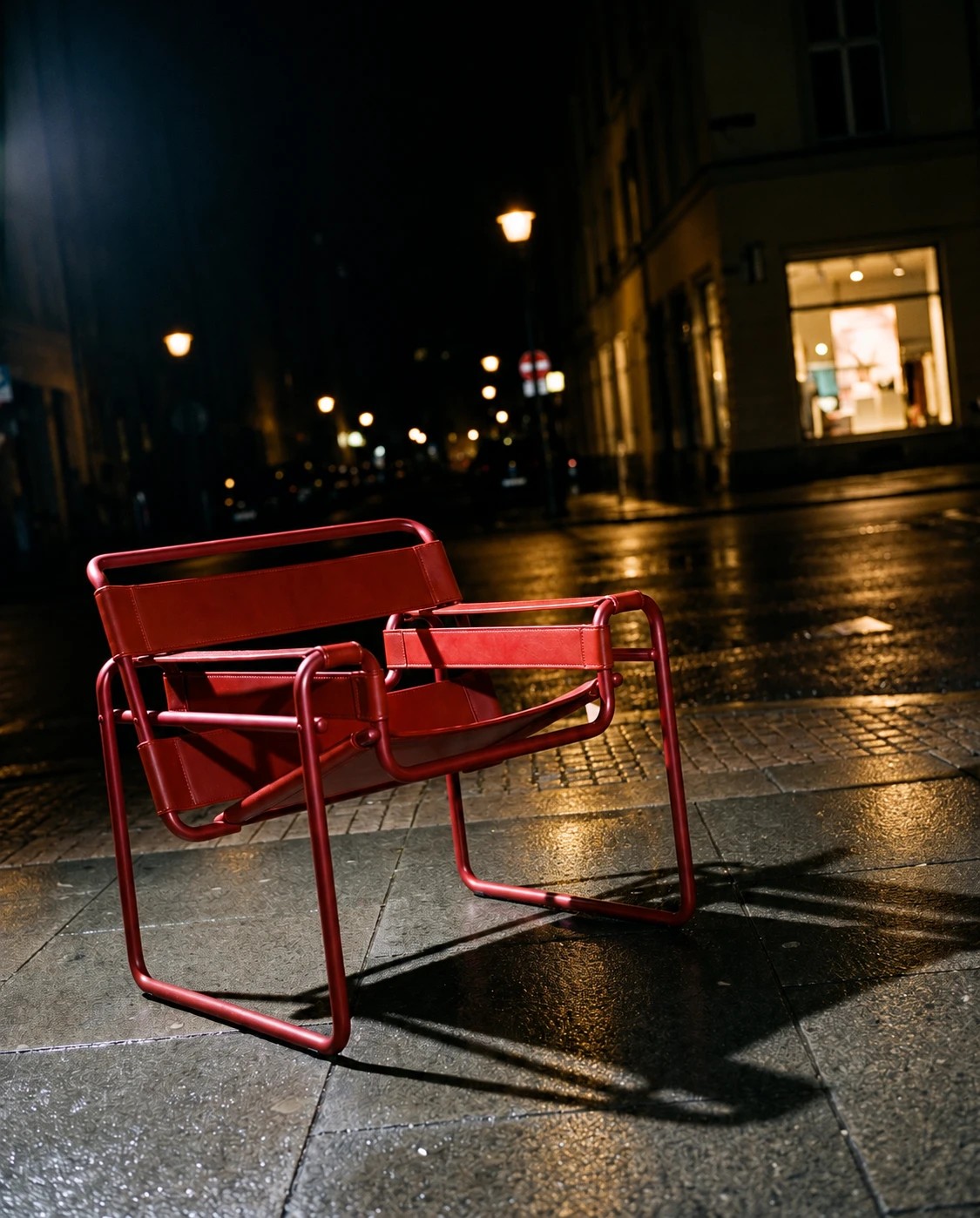
Night. A wet pavement. Streetlights in the distance, a lit window on the right. In the foreground, a red armchair stands. There’s no rug, coffee table, or bookshelf around it to explain its presence. After a while, we start thinking about things beyond the armchair’s form. How might it have gotten here? Has someone just left? Is it waiting for someone to arrive?
The street scene on Voss’s product page opens up these questions. In the situation created by the image, an everyday object stands outside its usual place. As we look at the design, we also start reading the story suggested by the scene.
The idea we derive from this is: In a furniture image, the form of the object and the life we associate with it become intertwined. Looking at them separately can help us better understand both the design and our own preferences.
What does the product image highlight?
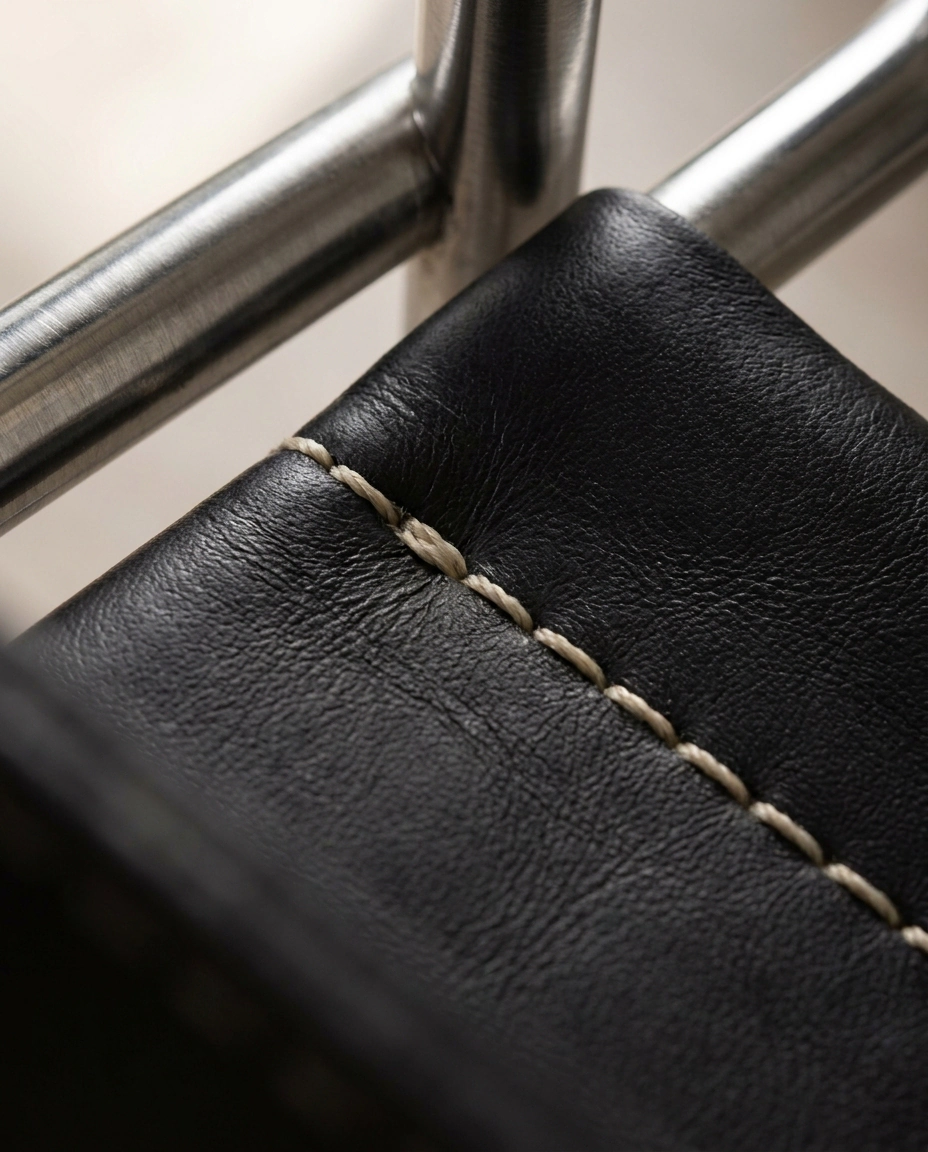
In Voss’s studio scene with a red background, the leather surfaces, stitching, and curved tubular frame become prominent. The red spreading from the floor to the background places the armchair in the same color world as its surroundings. Harsh shadows delineate the relationship between the tubes and the floor. There’s little everyday action for the eye to follow; this reading can direct attention to the surface, line, and void.
Across these scenes, light, angle, framing, and in some places, upholstery option change together. The comparison relies on the visual reading of different presentations. Voss in the street scene also opens up other questions. The red stands alone in the dark street. The wet ground reflects the light; the space around the armchair becomes a place one can walk around. We also imagine how closely we’ll look at the furniture and what we might do next to it.
In the lobby scene on the page, there’s another color and surface option. Dark leather, polished metal, a patterned rug, a wooden wall, and movement in the background place the armchair in a common waiting area. We recognize what a designated seating area looks like. The same design family, this time, participates in a more familiar usage arrangement.
With this comparison, we cannot measure how much the background affects preference. What we can do is distinguish which features are visible in each presentation and which story we add ourselves.
Red studio
- What we can see in the image
- Single-color environment, distinct shadows, stitching, and frame details
- What we add as interpretation
- Graphic, a sense of an independent object
Night street
- What we can see in the image
- Wet ground, distant lights, space around the armchair
- What we add as interpretation
- Expectation, transience, or an unexpected encounter
Lobby
- What we can see in the image
- Another upholstery option, rug, wood, and movement in the background
- What we add as interpretation
- Hospitality, shared use, and waiting
The right side of the table is suggested as a visual interpretation. Another viewer might see abandonment in the street armchair; someone else might find the scene playful. This difference is the productive part of the discussion. We can discuss which detail leads to which interpretation.
Looking at an object from its location
In art history, there are much sharper examples of how everyday objects are presented. Andy Warhol’s 1964 Brillo boxes were wooden sculptures bearing the appearance of supermarket packaging. MoMA’s work record describes the material as paint and silkscreen ink on wood. This detail is important: The object in the gallery was not made of the same material as a cardboard box taken from a shelf.
The Warhol example reminds us that when evaluating an object, its form, method of production, and context of display should be considered together. There is no reason to equate Voss with this work. The useful question here is how our perspective changes when we encounter a familiar form in a different place.
An armchair in a store is one product among options. In a home, it becomes a place where someone constantly sits. On a pavement, it can be a reason to stop and look. Function, ownership, proximity, and daily habits create different meanings around the same piece of furniture. If we consider all these meanings as inherent properties of the object alone, we might overlook the work done by context.
Which part of what we love belongs to the armchair?
This distinction also has implications in shopping. What we love in an image might be the product itself, along with the light in the frame, ceiling height, plants, and empty space. It might not be easy to separate the piece to be moved home from this whole.
For this, we can ask three separate questions when looking at an image. In the first, we describe only the object: How does its frame progress, where does the armrest connect, where does the seating surface end? In the second, we describe the scene: Where does the light come from, how crowded is the environment, which surfaces accompany each other? In the third, we state our own interpretation: What kind of life did we imagine here, and which part of that life do we want?
We can summarize this perspective in three lines:
What I see in the product
- Example
- The line of the frame, stitching, the form of the seating surface
- How to check?
- Product images from different angles and dimensions
What the scene adds
- Example
- Night light, wet ground, a sense of space and anticipation
- How to check?
- Comparison with images in other contexts
What I don’t yet know
- Example
- Seating comfort, the true color in my home, outdoor durability
- How to check?
- Seating experience, physical sample, and technical information
A strong image and one that provides all information about the product are separate matters. This distinction helps us see information gaps without diminishing our appreciation.
When we imagine the red armchair inside a home, we cannot bring the street from the scene with it. We will have our own light, our own floor, our bag left by the door. Perhaps this is where we will truly love the armchair: the small space where the life promised by the photograph meets the life already unfolding at home.
When discussing a piece of furniture, if we can distinguish what we see in the product, what the scene adds, and what we don’t yet know, it becomes possible to move beyond simply saying “beautiful” or “ugly.”
Previous article from NotesIs beige a taste, or a safe decision?